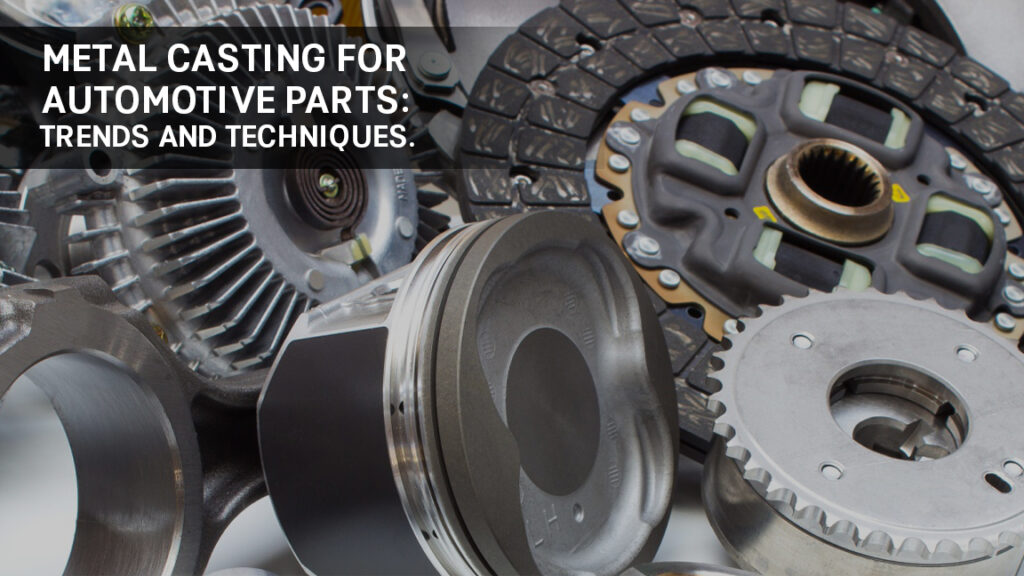
There is a metal casting somewhere in almost every part of a vehicle that matters under the engine, inside the gearbox, holding up the suspension, mounting the components that keep the whole thing together. The automotive industry leans on casting harder than almost any other, because casting is the most economical way to produce the complex, load-bearing shapes a vehicle needs in the volumes it needs them. But the industry is changing fast, and casting is changing with it. This is a look at where automotive casting is heading and the techniques carrying it there written from the perspective of a steel foundry that supplies the heavy, structural end of the vehicle.
Why Metal Casting Stays Central
For all the talk of new materials and new processes, casting remains hard to displace in automotive manufacturing, for a few solid reasons. It produces intricate internal and external geometry manifolds, housings, brackets that would be slow or impossible to fabricate. It works across a wide span of metals, so engineers can match the material to the duty. For volume production it usually delivers the lowest cost per part. And a well-designed casting offers an excellent strength-to-weight ratio and good fatigue resistance, which is exactly what structural and suspension parts demand.
The Trends Reshaping the Work Light weighting
The pressure to take weight out of vehicles is the single biggest force on the sector. A lighter car burns less fuel; a lighter electric vehicle goes further on a charge. That pushes a lot of work toward aluminum and magnesium for parts that used to be iron or steel engine blocks, housings, structural members. It also drives thinner walls, where casting and simulation together let designers remove material without losing integrity.
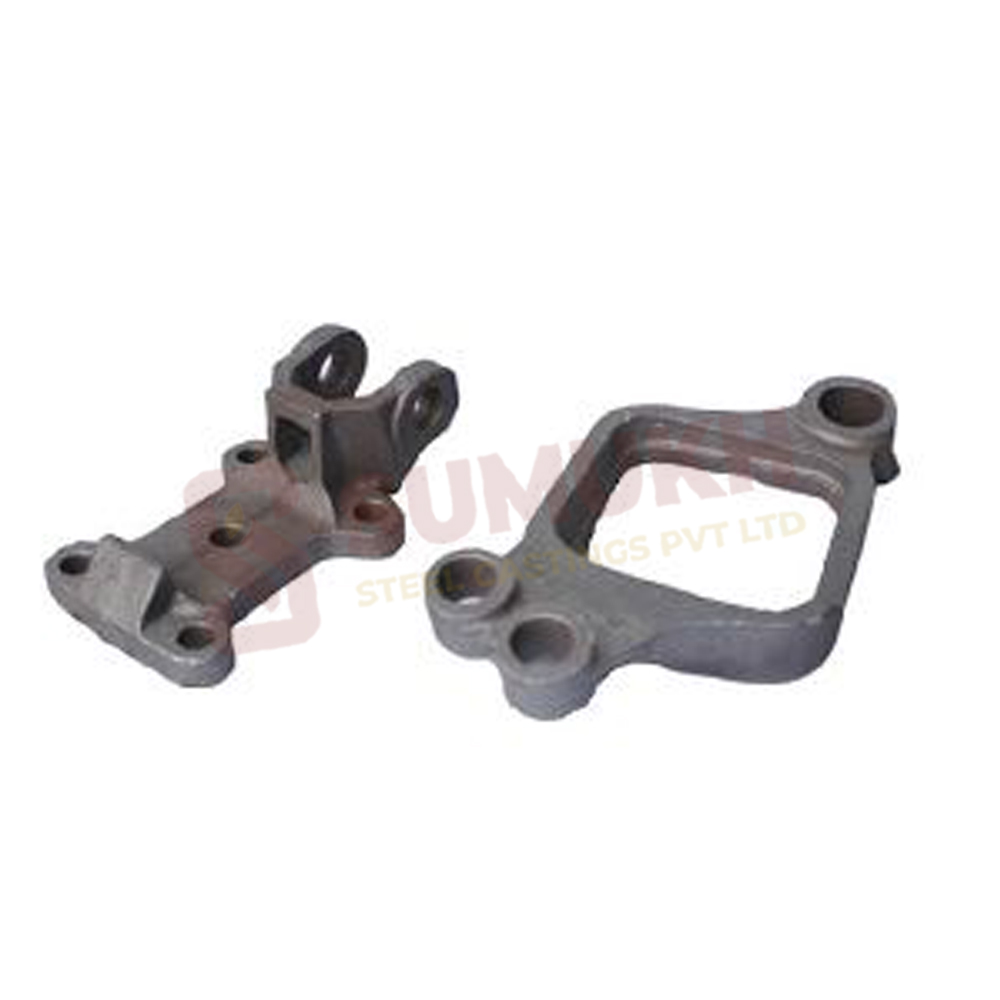
It is worth being clear-eyed about where steel still belongs, though. For parts that carry heavy, repeated loads suspension components, leaf-spring hangers, structural brackets on commercial vehicles the strength and fatigue life of a cast steel or low-alloy grade is exactly what the job needs. Light weighting is real, but it has not repealed the laws of mechanics. The heavy end of the vehicle still runs on steel castings, and on commercial vehicles especially it always will.
Electrification
The move to electric vehicles is rewriting the parts list. EVs need cast motor housings, battery enclosures, and cooling structures that traditional vehicles never had, and these parts put a premium on thermal management and structural integrity. At the same time the powertrain simplifies in some areas while adding new complex castings around power electronics and drivetrain integration. The net effect is not less casting it is different casting.
Simulation and Digital Design
The way castings are designed has shifted decisively toward simulation. Modelling mould filling and solidification before any metal is poured lets engineers predict and design out defects, optimize gating and feeding, and cut development time sharply. Topology optimization goes a step further, letting software work out where material actually needs to be for a given load case and the organic shapes it produces are often ideally suited to casting. This is now standard practice at any serious foundry rather than a novelty.
Sustainability
Environmental expectations are tightening across the supply chain, and automotive buyers increasingly require their suppliers to demonstrate it. Foundries are responding with more efficient melting, scrap recycling, sand reclamation, and cleaner binder systems. For a supplier hoping to stay on an OEM’s list, this is becoming a condition of entry rather than a bonus.
The Techniques Behind the Metal Casting
Different automotive parts call for different processes, and the choice is driven by metal, volume, and size.
High-pressure die casting dominates high-volume aluminum and magnesium work housings, cases, and increasingly large structural parts. Vacuum-assisted variants reduce porosity enough to allow heat treatment, and the very large “giga-press” machines now casting entire body sections in one shot are reshaping EV body manufacturing.
Low-pressure die casting fills permanent moulds gently, which reduces turbulence and gives cleaner metal with good mechanical properties. It is a common route for wheels and cylinder heads.
Sand casting, in its modern forms, remains essential for the larger, heavier, and lower-volume parts where permanent-mould tooling cannot be justified and for the ferrous structural and suspension components that are our core. Resin-coated and shell systems give it the surface finish and tolerances modern parts expect, and 3D-printed sand moulds now allow complex one-off and low-volume parts without traditional pattern-making.
Gravity die (permanent mould) casting sits in the middle for medium-to-high volume non-ferrous parts, trading some tooling cost for better mechanical properties than sand.
Squeeze casting applies pressure during solidification to eliminate porosity and approach forged-level properties, useful for the most highly stressed components.
Where Sumukh Fits
Our place in this picture is the steel end of it the suspension parts, hangers, brackets, and structural castings that commercial vehicles and heavier automotive applications depend on, poured to graded carbon and low-alloy specifications and finished to drawing. The industry’s move toward lighter aluminum parts grabs the headlines, but the load-bearing steel components underneath are no less critical, and they are what we build for.
Conclusion
Casting will stay at the center of automotive manufacturing because nothing else makes complex, strong parts as economically at volume. What is changing is the mix lighter alloys for some parts, new castings for electrification, simulation everywhere, and steady pressure to do it all more sustainably. The foundries that keep up with that shift, while still doing the fundamental metallurgy right, will keep supplying the parts that move the industry forward. For the structural steel castings that hold a vehicle together, that combination of modern technique and sound metallurgy is exactly what we aim to deliver.
FAQs
1. Why is metal casting important for automotive parts manufacturing?
Metal casting enables the production of durable, precise, and cost-effective automotive components with complex designs.
2. What are the latest trends in automotive metal casting?
Lightweight alloys, precision casting, automation, and sustainable manufacturing are the leading trends in automotive casting.
3. Which metals are commonly used in automotive casting?
Aluminum, steel, iron, and stainless steel are widely used for automotive castings due to their strength and performance.
4. How does precision casting improve automotive part quality?
Precision casting delivers tighter tolerances, smoother finishes, and reduced machining requirements.
5. What are the benefits of steel casting for automotive components?
Steel castings offer excellent strength, wear resistance, durability, and reliability for critical automotive applications.