Why the Grade Decision Is Not Cosmetic
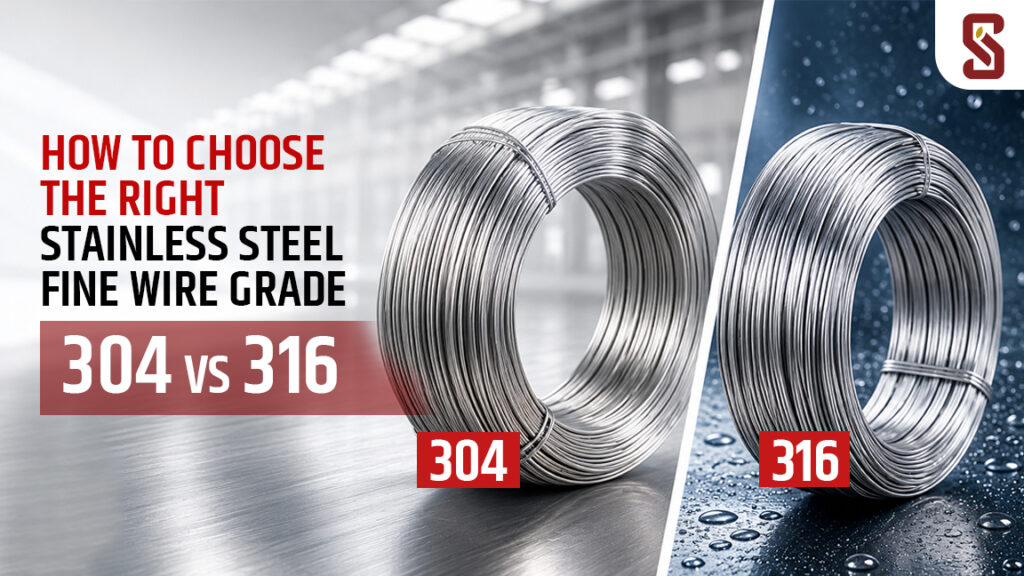
Picking the stainless steel grade for a fine wire application is one of those decisions that quietly governs everything downstream corrosion life, mechanical performance, weldability, and whether the finished product passes its regulatory checks. Yet engineers specifying fine wire for medical devices, filtration meshes, aerospace parts, or industrial sensors often reach for 304 or 316 by habit, without checking whether the grade actually matches the service conditions.
This guide lays out a practical way to make that choice, covering the grades used most often AISI 304, 304L, 316, and 316L and the application factors that should drive the decision rather than convention.
Why Grade Matters More in Fine Wire Than in Bar or Sheet
Fine wire, typically drawn to diameters between 0.10 mm and 0.80 mm, goes through severe cold deformation in the drawing process. That work hardening changes the wire’s properties significantly compared with the annealed base alloy:
- Tensile strength climbs sharply, often reaching 780 to 850 N/mm² depending on diameter and the drawing reduction
- Ductility falls as the material approaches its cold-work limit
- In metastable austenitic grades like 304, some austenite can transform to martensite, which affects magnetic permeability and corrosion behavior
The practical consequence is this: you cannot judge a grade purely on the annealed figures in the standard. You have to consider how it behaves after being drawn down to your target diameter.
The Key Grades at a Glance AISI 304 and 304L
Composition is roughly 18% chromium, 8 to 10% nickel, with carbon held at a maximum of 0.08% for 304 and 0.03% for 304L.
304 is the most widely produced austenitic stainless steel in the world and the natural baseline for general-purpose fine wire. It gives good corrosion resistance in mild environments, excellent formability, and reliable welding.
304L, the low-carbon version, is the one to specify when the wire will be welded or see heat cycling. The reduced carbon limits sensitization the precipitation of chromium carbides at grain boundaries that strips corrosion resistance from the heat-affected zone.
Where 304 and 304L fit best:
- General industrial filtration meshes
- Architectural and decorative wire
- Springs and formed parts in non-chloride environments
- Electrical conductors where magnetic neutrality is not critical
- Food-processing equipment in mild-duty conditions
Where they fall short:
- Not for chloride-rich settings such as marine, coastal, or chemical service
- Plain 304 should be avoided where post-weld corrosion resistance is critical
- A slight magnetic response can appear after heavy cold drawing
AISI 316 and 316L
Composition runs about 16 to 18% chromium, 10 to 14% nickel, 2 to 3% molybdenum, with the same 0.08% and 0.03% carbon limits for 316 and 316L respectively.
That 2 to 3% molybdenum is the whole point of 316. It is what lifts pitting and crevice corrosion resistance in saline and acidic media, and it is why 316 is the grade for chlorides, marine exposure, and aggressive chemical environments.
316L is usually the default for fine wire in critical applications, thanks to its better weldability and lower sensitization risk.
Where 316 and 316L fit best:
- Medical devices and surgical instruments, with 316L preferred for implantable or body-contact use
- Marine and offshore applications
- Chemical processing equipment
- Pharmaceutical and food equipment subject to frequent chlorinated washdown
- Precision meshes filtering corrosive liquids
- Electronics exposed to humidity or salt spray
Where they fall short:
- Higher cost than 304/304L because of the molybdenum
- Not suited to continuous high-temperature service much above 870°C (1600°F)
A Step-by-Step Way to Narrow the Choice
Step 1 — Define the service environment
| Environment | Recommended minimum grade |
| Dry indoor, mild atmosphere | 304 / 304L |
| Humid, mild chemical exposure | 304L |
| Chloride-containing (marine, coastal, saline) | 316 / 316L |
| Chemical processing (acids, solvents) | 316L |
Step 2 — Account for welding and joining
If the wire will be welded or brazed, prefer an L-grade (304L or 316L) to avoid sensitisation. Standard 304 and 316 are acceptable for welded work only if post-weld annealing is practical.
Step 3 — Check magnetic permeability needs
In MRI-compatible medical work, electronics, and some sensors, even a trace magnetic response is unacceptable. 316L generally shows lower residual magnetism after cold drawing than 304/304L, owing to its more stable austenitic structure. For the strictest non-magnetic requirements, specify the annealed condition and verify permeability with your supplier.
Step 4 — Consider the mechanical condition
Fine wire usually comes in one of two conditions:
- Annealed — softened after the final draw, more ductile, lower tensile strength, easier to form and weld
- Hard drawn — higher tensile strength (780 to 850 N/mm² depending on diameter), lower ductility, suited to load-bearing and spring use
Grade and condition interact. Hard-drawn 316L at 0.15 mm behaves quite differently from annealed 304 at the same diameter, so the two choices have to be made together.
Step 5 — Confirm the regulatory standard
Some industries dictate the grade regardless of pure engineering suitability:
- Implantable medical devices: ISO 5832-1 references 316L specifically
- Food contact: many national regulations accept 304 and 316 series
- Aerospace: AMS specifications may mandate a grade (for example AMS 5688 for 316L wire)
- Pharmaceutical: USP and EU GMP guidance often specify 316L for product-contact surfaces
Always check the governing standard before locking in the grade.
Summary Comparison
| Grade | Chloride resistance | Max service temp | Weldability | Typical use |
| 304 | Moderate | ~870°C (intermittent) | Good (sensitisation risk) | General industrial, architectural |
| 304L | Moderate | ~870°C | Excellent | Welded general purpose |
| 316 | High | ~870°C | Good | Marine, chemical, medical |
| 316L | High | ~870°C | Excellent | Medical, pharma, food |
Conclusion
Choosing a stainless fine wire grade is a multi-variable call: the environment, the mechanical demands, the joining method, and the applicable standard all feed into it. Defaulting to 304 saves money in benign conditions, while 316L is the sensible baseline for anything involving moisture, chlorides, or body contact. For genuinely high-temperature service, you move to stabilised grades like 316Ti or 321, or high-alloy grades like 310 and 314.
Sumukh Steel Casting works across the grades covered here. If you are unsure which one suits your application, talk to our technical team before placing an order a short conversation at the specification stage is far cheaper than a wrong grade in service.
Frequently Asked Questions
-
Q. Which stainless steel wire grade is best for corrosion resistance?
A.Grade 316 stainless steel wire offers excellent corrosion resistance, making it ideal for marine and chemical applications. -
Q. What is the difference between 304 and 316 stainless steel wire?
A.304 stainless steel wire is cost-effective for general use, while 316 provides superior resistance to corrosion and harsh environments. -
Q. How do I select the right stainless steel wire grade for industrial applications?
A.Choose the grade based on environmental conditions, strength requirements, temperature exposure, and corrosion resistance needs. -
Q. Is stainless steel wire suitable for high-temperature applications?
A.Yes, specific grades like 310 and 316 stainless steel wire perform well in elevated temperature environments. -
Q. Why is choosing the correct stainless steel wire grade important?
A.The right grade ensures durability, performance, reduced maintenance costs, and longer service life.