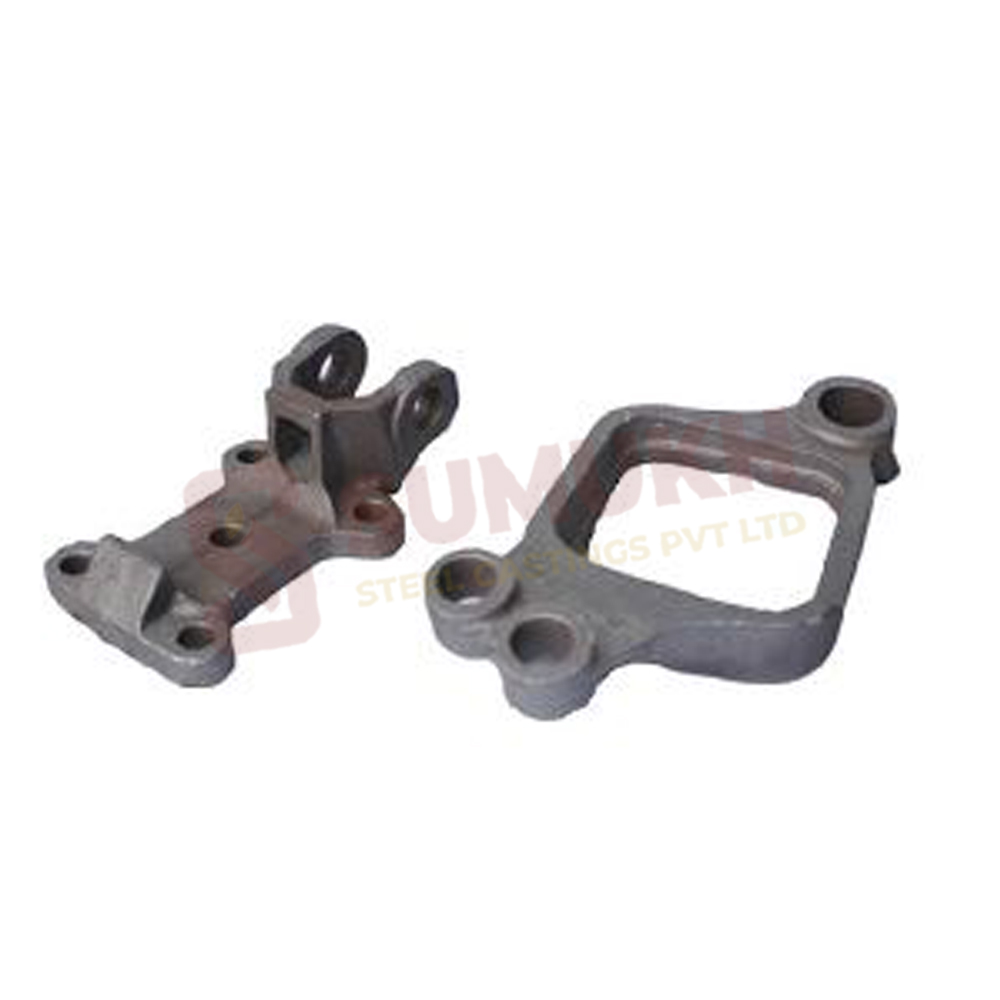
India stopped being just an assembly shop a long time ago. These days the country pours, machines and ships the critical metal that keeps plants running everywhere from the Gulf to Germany. Steel casting sits quietly at the centre of that shift, and we’ve had a front-row seat to it. At Sumukh Steel Castings, we’ve been running an induction-melt foundry at Gokul Shirgaon MIDC in Kolhapur since 2009, and the change has been hard to miss — drawings that once went only to Europe or Turkey now land on Indian foundry desks and leave as finished castings that hold up in pumps, valves, mining gear and defence equipment.
A good steel casting is never glamorous. It simply has to do its job — carry load, resist wear, shrug off corrosion — for years, often in conditions that would tear a lesser part apart. That quiet reliability is the entire point of the work, and it’s what separates a foundry that prints brochures from one that genuinely understands what’s happening inside the metal.
So what is steel casting, really?
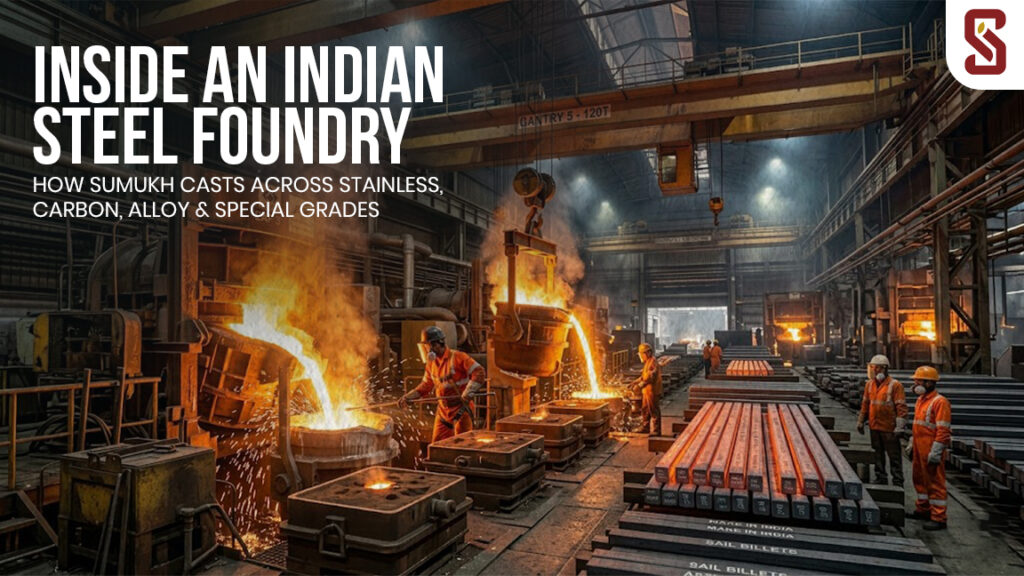
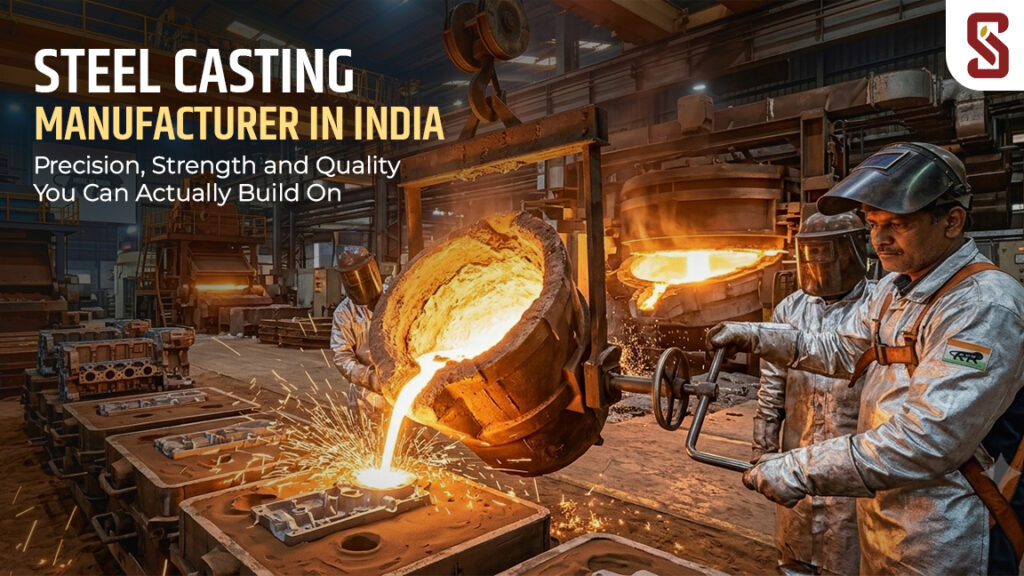
Strip away the jargon and it’s straightforward: we melt steel, pour it into a mould shaped like the part you need, and let it solidify. After that comes the work most people never see — fettling, heat treatment, machining and inspection — until the casting hits the dimensions and mechanical properties on your drawing. On our floor that molten steel comes out of 500 kg and 1,000 kg induction furnaces, and every heat is checked on a Bruker Q4 spectrometer before it’s allowed anywhere near a mould.
Why cast instead of forge or fabricate? A few honest reasons:
- You can build complex, hollow or organic shapes in one piece that would be a nightmare to weld up.
- Near-net shape means less machining and less scrap, which keeps the price sensible on intricate parts.
- You get to dial in the alloy — corrosion resistance here, abrasion resistance there — rather than living with whatever a bar stock gives you.
- For most batch sizes in our range, casting is simply the cheaper route to a strong, sound component.
Why source your castings from an Indian foundry
People usually assume the answer is just price. It’s part of it, but it isn’t the whole story.
Capable shops, not just cheap ones
The better Indian foundries run modern melting, moulding and machining alongside proper test labs. We pour through shell, CO₂, no-bake and lost-foam routes depending on what the part demands, and we simulate the mould filling and solidification in AutoCAST X1 before we cut a single pattern. That front-loading is what stops the surprises later.
Cost that still leaves room for quality
Yes, our landed cost tends to beat European or Turkish sourcing. The point is doing that without thinning out the metallurgy or the inspection — a cheap casting that fails in service isn’t cheap at all once you count the downtime.
Engineers who’ve actually stood at the furnace
India has a deep bench of metallurgists and foundrymen, and the good ones learned the trade on the shop floor, not just in a textbook. When a drawing arrives with a tricky section change or a tight RT requirement, that experience is what turns it into a sound part.
Standards that travel
We work to ISO 9001 (certified by TÜV SÜD) and pour to international ASTM and equivalent specifications, so a casting leaving Kolhapur answers to the same rule book your QA team uses.
The stainless grades we pour at Sumukh
Stainless is where a lot of our work sits, so it’s worth being precise. One thing worth knowing up front: the cast versions carry their own ACI designations. Wrought 304 becomes CF8 in the foundry, and 316 becomes CF8M — same family, cast chemistry. Here’s how we use the common grades.
304 / CF8
The workhorse austenitic grade. Good corrosion resistance, weldable, tough, and forgiving to machine. We use it across food and dairy equipment, pump bodies, valve parts and general process machinery where the environment is corrosive but not aggressive.
304L / CF3
The low-carbon cousin of 304. Knocking the carbon down means far less risk of carbide precipitation at the grain boundaries when a part gets welded, so it’s the sensible pick for welded fabrications and chemical or pharma duty.
316 / CF8M
Add molybdenum and the chloride resistance jumps — which is exactly why 316 stainless steel castings end up in marine fittings, offshore gear, chemical plants and anything that sees salt or harsh process media.
316L / CF3M
Same moly-boosted corrosion resistance as 316, but with the low-carbon advantage for welded assemblies. We reach for it on welded stainless structures, pharma equipment and food machinery that has to take repeated cleaning.
410 / CA15
A martensitic grade — this is the one you harden. It trades some corrosion resistance for real strength and wear resistance, so it suits valve trim, pump wear parts, fasteners and mining components that have to take a beating.
Across all of them the brief is the same: consistent chemistry heat to heat, sound bodies, and dimensions that don’t drift. That only happens with disciplined melt control and inspection, not luck.
Where our castings end up
Pumps, valves and process equipment
Bodies, impellers, casings and trim — the parts that decide whether a pump or valve survives its design life. Corrosion-resistant stainless does the heavy lifting here.
Mining and earthmoving
Abrasion is relentless in mining, so this is wear-resistant alloy territory — components that have to keep their shape under load and grit far longer than a plain casting would.
Oil, gas and chemical
Flanges, valve bodies and pressure-retaining parts where a corrosion failure isn’t an inconvenience, it’s a safety event. Stainless and controlled-chemistry alloys are non-negotiable.
Power and heavy engineering
Castings that run hot or carry serious structural load, where soundness and repeatable mechanicals matter more than anything else.
Defence and general industry
We pour to drawing for defence and OEM customers where traceability, documentation and dimensional discipline are part of the deal, not an extra.
How we keep the quality honest
Quality on castings isn’t a final-inspection stamp — it’s earned at every stage, and it’s mostly about catching problems before they’re cast in. Across a job we’ll run:
- Spectro chemistry on every heat (our Bruker Q4) before tapping
- Mechanical testing — tensile, hardness, impact as the spec calls for
- Radiography (RT) and ultrasonic testing (UT) for internal soundness
- Magnetic particle (MPI) and dye penetrant (DPT) for surface integrity
- Dimensional inspection against the drawing
And because we simulate solidification in AutoCAST before tooling, a lot of would-be shrinkage and porosity problems are designed out of the methoding rather than found on the X-ray film. That’s the cheapest defect to fix — the one that never forms.
Choosing the right casting partner
If you’re evaluating foundries, the brochure tells you very little. What actually predicts whether you’ll get good parts on time is more practical:
- Real experience with your kind of component and grade
- Honest capacity — can they hold your schedule when it gets busy?
- The grade range you need, poured in-house
- Live, working quality systems and certifications
- In-house machining, or a tight handle on it
- A proper test and inspection setup, not outsourced guesswork
- A track record of actually shipping on the date they promised
Tick those and the relationship tends to pay back for years. Miss them and you’ll spend that saving on rejections and chasing.
Why customers keep coming back to Sumukh
We’re not the biggest foundry in India and we don’t pretend to be. What we offer is a tightly run shop where the founder still reads the drawings, the methoding is simulated before tooling, and every heat is checked before it’s poured. We supply stainless, carbon and alloy steel castings to OEMs across compressor, process-equipment, pump and defence segments — and the reason they re-order is dull but important: the parts are right, and they arrive when we said they would.
The bottom line
India’s casting industry has quietly become a reliable backbone for global manufacturing — not because it’s cheap, but because the better shops have learned to combine sensible cost with real metallurgical discipline. Whether your part is stainless, carbon or alloy, the foundry you pick decides whether it’s a component you forget about or one that keeps coming back to haunt your maintenance budget. We’d rather be the kind you forget about, in the best possible way.
FAQs
Which industries actually use steel castings?
Pretty much every heavy sector — pumps and valves, mining, oil and gas, power, railways, defence, agriculture and general heavy engineering. Anywhere a part has to take load, heat or wear, there’s usually a casting behind it.
Why is stainless cast steel so popular?
Because it gives you corrosion resistance, strength and a long service life in one part. In wet, salty or chemically aggressive service, that combination is hard to beat.
What’s the real difference between carbon and alloy steel castings?
Carbon steel gives you strength and toughness at a sensible price. Alloy steel adds elements — chromium, nickel, molybdenum and so on — to buy extra wear resistance, heat resistance or hardenability when the duty demands it.
How do you test castings before they ship?
Spectro chemistry on every heat, mechanical tests, RT and UT for internal soundness, MPI and DPT for the surface, and full dimensional checks — scaled to whatever the customer spec requires.
Why source from an Indian foundry at all?
Capable plant, skilled foundrymen, competitive landed cost and compliance with the same international standards your QA team already works to. Done properly, you don’t trade quality for price.
Need castings you don’t have to worry about? Talk to Sumukh Steel Castings about your stainless, carbon or alloy steel requirement. Send us the drawing and we’ll come back with a route, a price and a realistic delivery date. Request a quote today.