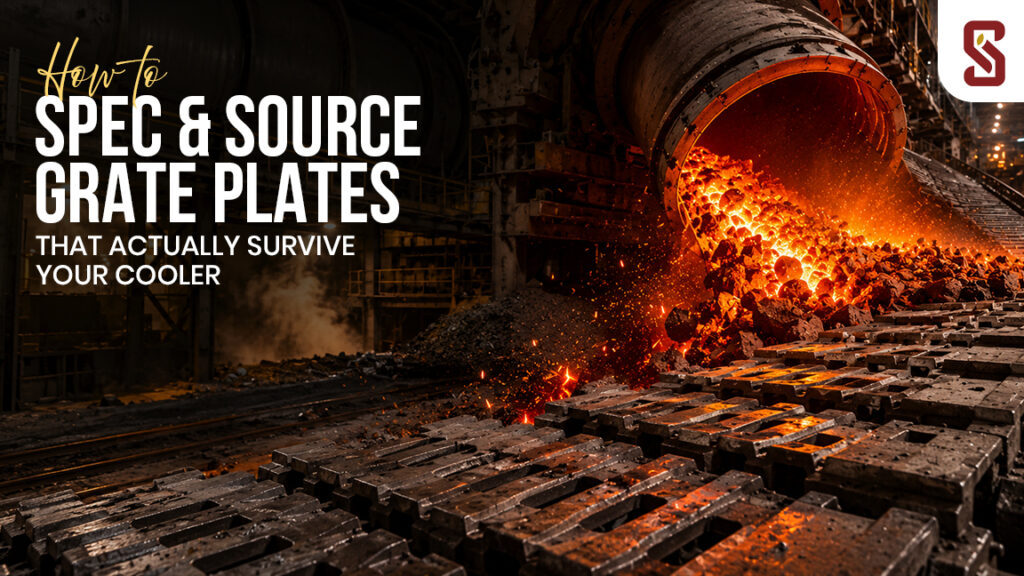
Most grate-plate failures aren’t bad luck — they’re a sourcing decision that came back to bite. A plate bought purely on price, or poured to a vague “heat-resistant” line on a PO, will warp and crack in the hot zone long before it should. We pour heat-resistant grate plates for cement coolers, and we see the same avoidable mistakes often enough that it’s worth writing down how to get the specification and the supplier right the first time.
Start by mapping the duty, not the part
A grate plate isn’t one component in one condition — it’s the same casting asked to survive three very different positions in the cooler. Before you spec anything, be clear on which zone you’re buying for, because that single fact drives the grade choice:
| Cooler zone | Working temperature | What kills the plate |
| Hot zone (kiln drop) | Up to ~1,400 °C | Impact from falling clinker plus thermal shock from uneven heating |
| Intermediate zone | ~600–1,000 °C | Combined thermal cycling and mechanical load |
| Cold zone | Below ~600 °C | Abrasive wear as material is conveyed along |
The hot zone takes mechanical impact from falling clinker plus thermal shock from uneven heating — that’s where the metallurgy has to be uncompromising. The cooler positions are more about abrasive wear. Treating all three the same is the most common and most expensive spec error we see.
Spec the grade explicitly — don’t leave it to chance
“Heat-resistant” on a drawing isn’t a specification; it’s a hope. For the hot positions, name the family: a Cr-Ni austenitic heat-resistant steel such as HK40 (roughly 25Cr-20Ni) is the proven default because it keeps its strength and resists oxidation and sulphur attack at temperature. Pin down:
- The grade and its chemistry limits — not just a trade name
- The mechanical properties you actually need at temperature
- A thicker working face where the clinker lands, for high-temperature wear life
- Geometry that distributes cooling air evenly — a plate that cools itself fatigues far slower
If a supplier can’t speak fluently about chemistry limits and why a grade behaves the way it does at red heat, that tells you something before you’ve placed the order.
Vet the foundry, not just the quote
Two quotes for “HK40 grate plates” can be wildly different products. What separates a plate that lasts from one that fails early is the discipline behind it, so ask:
- Do they verify every heat? Spectro chemistry on each melt — at Sumukh that’s our Bruker Q4 — is the difference between a real heat-resistant grade and one that’s nominally close.
- Do they simulate the casting? We run AutoCAST on the methoding so shrinkage and porosity are designed out before tooling. A plate that’s internally unsound fails fast no matter what the chemistry says.
- Can they prove soundness? RT, UT, MPI and DPT as the part warrants — with records you can keep.
- Is there a real quality system? Ours runs under ISO 9001 certified by TÜV SÜD, which keeps results repeatable rather than batch-to-batch luck.
Think in cost-per-tonne-of-clinker, not price-per-plate
This is the mindset shift that saves real money. A cheaper plate that warps early forces an unplanned shutdown, drops your cooler’s heat recovery, and pushes up fuel use until it’s changed — and downtime on a cooler is expensive in ways a purchase price never captures. A properly specified plate costs a little more up front and quietly returns it through longer life, steadier heat recovery and lower fuel and maintenance bills. Judge plates by what they cost you per tonne of clinker over their life, not by the line on the quotation.
Build a maintenance rhythm, then hold to it
Even a perfect plate is a consumable. The plants that get the best out of theirs do three unglamorous things: they inspect on a fixed routine, they change worn plates before efficiency slides rather than after, and they accept that different zones wear differently and may warrant different grades. A foundry that understands the duty can help you zone your material choice so you’re not over-paying for the cold positions or under-specifying the hot ones.
The short version
Good grate-plate sourcing is three decisions, in order: map the zone and its duty, specify the grade and geometry explicitly, and choose a foundry that verifies its metal and proves its soundness. Do that and the plates stop being a recurring headache and become what they should be — a small, predictable consumable that keeps your cooler hitting its numbers.
Frequently Asked Questions
-
Q. What material is best for cement cooler grate plates?
A.Heat-resistant steel grades such as HK40 are commonly used for cement cooler grate plates in high-temperature zones. The appropriate material depends on operating temperature, clinker impact, thermal cycling, and wear conditions. -
Q. How do I choose the right grate plate for a cement cooler?
A.Consider the cooler zone, operating temperature, clinker impact, abrasive wear, plate geometry, and cooling air distribution. Selecting the correct material and design helps improve service life and cooler performance. -
Q. Why do cement cooler grate plates crack or warp?
A.Grate plates may crack or warp due to thermal shock, repeated heating and cooling, mechanical impact from clinker, unsuitable material selection, or casting defects. Proper material specification and quality inspection help reduce these risks. -
Q. What quality tests should be performed on cement cooler grate plates?
A.Quality checks may include chemical composition analysis, dimensional inspection, and non-destructive testing such as radiographic testing (RT), ultrasonic testing (UT), magnetic particle inspection (MPI), and dye penetrant testing (DPT), depending on the component specifications. -
Q. Specifying grate plates for a cooler upgrade or change-out?
A.Send Sumukh Steel Castings your zone details and drawings — we'll recommend the grade, verify the metal heat by heat, and back it with simulation and inspection. Website: sumukhsteelcast.com Phone: +91 9260006666 Email: dhruv@sumukhsteelcast.com Specialisation: Carbon, alloy and heat-resistant steel castings for cement plants