Let me start with a confession. I run a steel foundry, and I lose orders on price almost every month.
Someone, somewhere, will always quote a little less per kg than us. I’ve made peace with that. What I haven’t made peace with is watching a good buyer pick the lowest quote, and then spend the next six months fighting fires that never needed to start.
So this isn’t a sales pitch. It’s what I’ve learned in over 15 years of pouring steel in Kolhapur, about what actually happens after you release a purchase order.
The moment the PO goes out, the power shifts
Before the PO, the buyer holds all the cards. Every foundry is polite, quick to reply, and full of promises.
After the PO, things change quietly. The pattern is at the foundry. The schedule is committed to your own customer. Switching suppliers now means new samples, new approvals and lost weeks.
This is exactly when you find out who you really chose. Not in the quotation, but in the third month, when a casting cracks in heat treatment and someone has to pick up the phone and tell you honestly.
Where a cheap casting quietly gets expensive
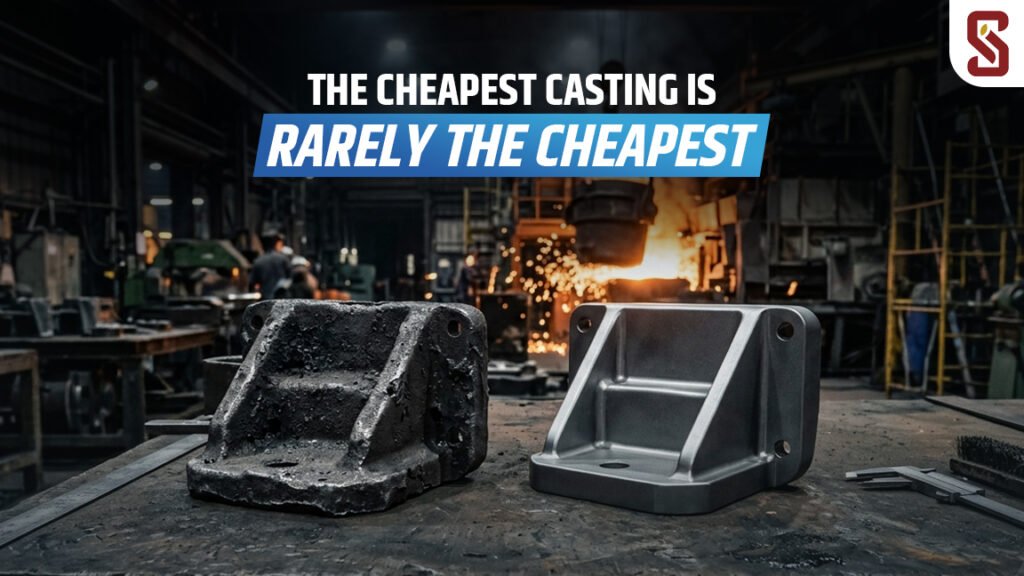
The defect you find after machining. A shrinkage cavity hidden under the skin doesn’t show up at receiving. It shows up after your machine shop has spent hours on it. By then, whatever you saved per kg is gone many times over.
The delivery that slips by three weeks. Many foundries say yes to everything to fill capacity. Then your order waits in a queue. Your assembly line waits too, and so does your customer.
The second batch that isn’t like the first. Samples are made with extra care. Regular production is where discipline shows. If chemistry, hardness or dimensions drift lot to lot, you end up inspecting every single piece yourself.
The missing paperwork. A test certificate that doesn’t match the heat, or radiography reports that arrive late, can hold up an entire shipment at your customer’s end.
The failure in the field. This is the costly one. A casting that fails in a pump, a valve or a compressor doesn’t come back to the foundry’s reputation. It comes back to yours.
None of these costs show up in the quotation comparison sheet. All of them show up on your balance sheet.
What good service actually looks like
Service is a big word that gets used loosely. On a foundry floor, it means a few very practical things.
- Someone who looks at your drawing before quoting it. A good foundry will tell you upfront if a thin section, a hot spot or a tough tolerance is going to cause trouble, and suggest a fix.
- Bad news, early. If a heat goes wrong or a mould fails, you hear about it from us the same day, not when the truck doesn’t arrive.
- Owning the problem. When a rejection happens (and in castings, it eventually will), a reliable foundry finds the root cause and fixes the process. It doesn’t argue about whose fault it is.
- Traceability. Every casting should be linked to its heat number, its chemistry and its heat treatment record. If you ask, the answer should come in minutes.
- Delivery dates you can plan around. Not the most optimistic date, but the honest one, and then keeping it.
Reliability is boring. It means the tenth order behaves exactly like the first. That boredom is worth a lot of money to a buyer.
Five questions worth asking before you release the PO
If I were buying castings, these are the questions I would ask any foundry, including mine.
- What was your on-time delivery rate in the last six months? Can you show me the data?
- What is your internal rejection rate, and what is your biggest defect right now?
- Who will I talk to when something goes wrong, and how fast will they respond?
- Can you show me a complete traceability record for a casting you shipped last month?
- Can I walk through your melting, moulding and fettling areas?
A foundry that answers these openly is usually one you can trust. A foundry that gets defensive is telling you something too.
A final word
Price matters. I won’t pretend it doesn’t. Every buyer has targets, and every foundry, including ours, has to earn its price.
But a casting isn’t a commodity you buy once and forget. It goes into a machine that has your name on it. The foundry you choose becomes part of your team, whether you planned it that way or not.
So compare quotes, by all means. Just also ask yourself one simple question: when something goes wrong, and it will, who do I want on the other end of the phone?
That answer is usually worth more than any discount per kg.
— Dhruv Mendapara, Founder & Managing Director, Sumukh Steel Castings Pvt. Ltd., Kolhapur
Frequently Asked Questions
-
Q. Why is the cheapest steel casting not always the most cost-effective option?
A.The cheapest steel casting may lead to higher costs due to defects, machining waste, production delays, rework, and field failures. Choosing a reliable steel casting manufacturer helps reduce these risks and improve long-term cost efficiency. -
Q. What quality issues can increase the cost of steel castings?
A.Common issues include shrinkage cavities, porosity, dimensional inaccuracies, inconsistent chemical composition, and heat treatment defects. These problems can cause rejection, additional machining, production delays, and equipment failures. -
Q. How can buyers evaluate a reliable steel casting manufacturer?
A.Buyers should evaluate a foundry's quality control processes, on-time delivery performance, rejection rates, material testing, traceability records, and ability to meet technical specifications before placing an order. -
Q. Why is traceability important in steel casting manufacturing?
A.Traceability links each casting to its heat number, chemical composition, inspection results, and heat treatment records. It helps manufacturers investigate defects, maintain quality consistency, and meet customer requirements. -
Q. What questions should buyers ask before selecting a steel casting supplier?
A.Buyers should ask about delivery performance, internal rejection rates, defect prevention methods, material test certificates, traceability systems, and the supplier's process for handling quality issues. These questions help identify a dependable long-term manufacturing partner. Is this conversation helpful so far?