Every few weeks, someone across the table asks us the same thing: “Shouldn’t this part be forged? Isn’t forging just stronger?”
It’s a fair question. And as people who pour steel for a living, you might expect us to say “casting, always.” We won’t. The honest answer is that neither process is better. Each one is the right tool for a certain kind of job, and the trick is knowing which job you actually have.
So let’s talk about it the way we would over a cup of tea at the foundry, without the sales pitch.
Two very different ways to shape steel
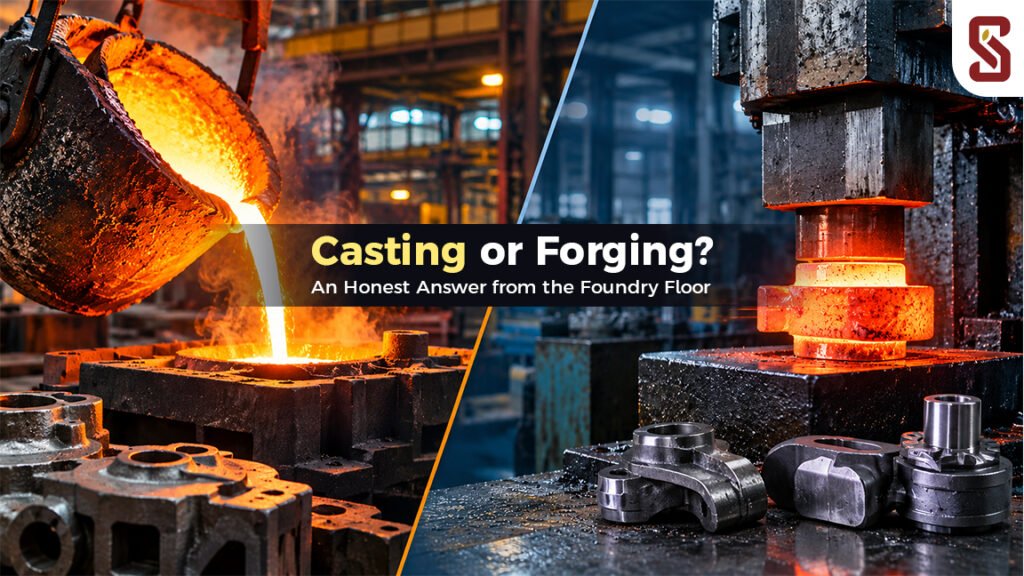
Casting is the older idea. We melt steel, pour it into a mould shaped like the part, and let it solidify. Whatever shape the mould has, the steel takes. Hollow passages, curved walls, ribs, bosses, all in one piece.
Forging starts with solid steel. A heated billet is pressed or hammered into shape, either between closed dies or on an open anvil. The metal is never liquid. It is squeezed and pushed until it fills the form.
That single difference, liquid versus solid, explains almost everything that follows.
When steel is forged, its internal grain gets stretched and aligned along the shape of the part, a bit like the grain in a piece of wood. Any tiny voids inside get squeezed shut. That’s why forgings have such a good reputation for toughness.
When steel is cast, it solidifies from the outside in, and it shrinks as it does. If the mould and feeding system aren’t designed well, that shrinkage can leave small cavities inside. On the flip side, a casting has no grain direction. It behaves the same way whichever way you load it.
“But isn’t forging stronger?”
This is the belief we hear most, and it’s only half true.
Take the same steel grade, give it the same heat treatment, and the tensile and yield strength of a casting and a forging come out remarkably close. Cast WCB and forged A105 are near cousins. So are CF8M and F316, and CA6NM and F6NM.
Where forgings genuinely pull ahead is in three things:
- Fatigue life, for parts that are loaded and unloaded millions of times.
- Impact toughness and ductility, for parts that take shocks.
- Consistency, because there’s less piece-to-piece variation to worry about.
The design codes recognise this. Pressure vessel rules, for example, apply a quality factor to castings that can be raised close to that of a forging when the casting gets extra inspection. In other words, a properly inspected casting earns its place. It isn’t treated as second best.
Where casting simply makes more sense
When the shape is complicated. Look at a valve body or a pump casing auto mobile . There’s a hollow inside, curved flow paths, flanges at odd angles, and walls that thicken and thin. No hammer can make that in one piece. A mould can, and it does it near to final shape, so far less metal is machined away.
When the alloy won’t forge. Some of the hardest-working steels in industry are practically cast-only. High-chromium white irons for wear liners, high-carbon heat-resistant grades like HK40 for furnace parts, and manganese steel for crusher jaws are all cast for a reason.
When the part is big. Casting handles parts weighing several tonnes with complex shapes. Forging that size usually means making a simple block and then machining most of it away, which is expensive and wasteful.
When volumes are modest. A forging die is a serious investment and needs large quantities to pay for itself. A casting pattern costs far less. For tens or hundreds of pieces, casting usually wins comfortably.
When you need the same properties in every direction. Because a casting has no grain flow, it doesn’t have a weak direction either.
Where forging deserves the job
We’d be doing you a disservice if we pretended casting fits everything. It doesn’t.
If your part is a fairly simple shape that gets hammered by cyclic or shock loads, such as a crankshaft, a connecting rod, a gear blank, an axle or a lifting hook, forging is usually the right call. That aligned grain is exactly what those parts need.
The same goes for small, high-pressure valve bodies made in big numbers, and for large, simple, safety-critical parts like rotor shafts. There, forging’s consistency is worth paying for.
A good supplier, whichever process they run, should tell you this plainly.
The cost question nobody asks early enough
Buyers often compare the price per kilo of a casting against a forging and stop there. That’s where good decisions go wrong.
The real comparison is the cost of a finished, machined, inspected part. A forged block may look cheaper per kilo, but if half of it ends up as swarf on the machine shop floor, you’ve paid for steel you threw away, plus the hours to remove it. This matters most in stainless and duplex grades, where both the material and the machining are expensive.
Then there’s tooling. A forging die only makes sense at volume. A casting pattern costs a fraction of that, and for prototypes, lost-foam or printed sand moulds can remove tooling cost almost entirely.
And be fair to both sides: critical castings need inspection, such as radiography or ultrasonic testing. Put that cost into the comparison from day one instead of discovering it later.
What separates a good casting from a risky one
Most bad experiences with castings come down to process, not to casting itself. A casting from a careful foundry and one from a careless foundry can be worlds apart. Here’s what makes the difference:
- Methoding. Gating and feeding are designed, and often simulated, so that any shrinkage ends up in the risers and not in the part.
- Clean melting. Proper deoxidation and control of inclusions and gas. Good steel starts in the furnace.
- Correct heat treatment. Normalising and tempering, quench and tempering, or solution annealing for stainless grades, done to the specification.
- Agreed inspection. Radiography, ultrasonic, magnetic particle or dye penetrant testing, with acceptance levels agreed before the order, not argued over after.
- Honest test bars. Mechanical and impact tests from the same heat, so the certificate tells the truth about the part.
When these are in place, a casting doesn’t need excuses. It’s simply the right engineering answer for the shape.
So, which one should you choose?
If you remember just one thing, make it this.
| Your part looks like… | Lean towards |
| Hollow, curved or complex inside (valve bodies, pump casings, impellers) | Casting |
| Simple and solid, under repeated shock or fatigue (shafts, rods, gears, hooks) | Forging |
| Made from a wear-resistant, heat-resistant or manganese grade | Casting |
| Large and complex, weighing hundreds of kilos or more | Casting |
| Small and made in very large numbers | Forging |
| Tens or hundreds of pieces of a complex shape | Casting |
Forge when the part is simple, carries fatigue or shock, and is made in volume. Cast when the shape is complex, the alloy demands it, the part is large, or the numbers don’t justify a die.
The best decisions we’ve seen came from buyers and designers who brought us into the conversation early, before the drawing was frozen. A small change to a wall thickness or a fillet radius can make a part easier to cast, cheaper to machine and more reliable in service.
So if you’re unsure, ask. We’d much rather help you pick the right process than sell you the wrong one.
Frequently Asked Questions
-
Q. What is the main difference between casting and forging?
A.Casting involves pouring molten metal into a mould to create a desired shape, while forging shapes solid metal using compressive force. Casting is ideal for complex geometries, whereas forging is often preferred for components requiring high strength and toughness. -
Q. Is casting better than forging for industrial components?
A.Neither process is universally better. Casting is suitable for complex shapes, larger components, and designs that are difficult to forge. Forging is often preferred for parts subjected to high impact and fatigue loads. The best choice depends on the component's design, material requirements, operating conditions, and budget. -
Q. How do I choose between casting and forging for my application?
A.Consider the component's shape, required mechanical properties, production volume, machining needs, and overall cost. Casting can offer greater design flexibility, while forging may provide improved mechanical properties for certain applications. Consulting an experienced manufacturer helps identify the most suitable process for your requirements.