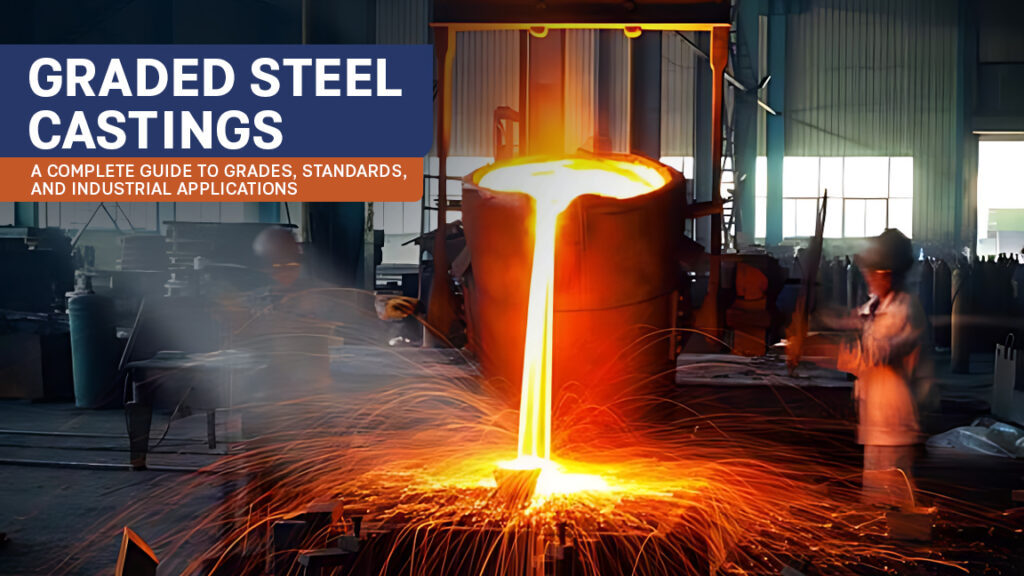
Graded steel casting starts with choosing the right material even before the actual pour or evaluation of shape takes place. The very first parameter that must be looked into once we receive a drawing from an OEM is the grade identification. It dictates everything from how we mix our charges and the temperature at which we will pour the molten metal to the heat treatment process that will be followed, whether it is the process of normalizing or quenching and tempering. In addition, it determines the standards for testing and inspection. In the end, a casting’s effectiveness lies in its grading.
This guide walks through what graded steel castings actually are, the main families we pour at Sumukh Steel, the standards that govern them, and where each grade earns its place on a machine.
What Graded Really Means
A graded steel casting is one made to a defined chemical composition and a defined set of mechanical properties, with both verified before the part ships. The grade fixes the chemistry within tight bands, and the heat treatment that follows develops the strength, hardness, and toughness the application needs.
The difference matters in service. An ungraded casting might look identical to a graded one, but you have no guarantee of its yield strength, its behavior at low temperature, or how it will respond to a weld repair. A graded casting carries that guarantee because every heat is checked on a spectrometer and, where required, backed by tensile, impact, and hardness results from a test bar poured alongside the job. That is the reason critical parts in pumps, valves, defense equipment, and earth-moving machinery are specified to a grade rather than left to chance.
The Main Families of Graded Steel Castings
Most of the work that comes through an Indian foundry falls into a handful of families. Each exists because a class of applications needed something the others could not give.
Carbon Steel Castings
Carbon steel is the workhorse. With carbon broadly between 0.2 and 0.5 percent and only residual alloying, it offers a sensible balance of strength, toughness, and cost, and it machines and welds without drama. The common specifications are ASTM A216 grades WCA, WCB, and WCC for valve and pressure-containing parts, and IS 1030 grades for general engineering castings. WCB in particular is one of the most-poured grades in the world because it covers an enormous range of brackets, housings, valve bodies, and structural parts at moderate cost.
Low Alloy Steel Castings
When carbon steel runs out of strength, low alloy steel takes over. Small additions of chromium, nickel, molybdenum, or manganese lift the strength, fatigue life, and wear resistance well above plain carbon grades. ASTM A148, which runs from grade 80-50 up through 150-135, is the usual reference for higher-strength structural castings, while 42CrMo4 is a familiar choice where a tough, through-harden able section is needed. These grades suit suspension components, vehicle hangers, and heavily loaded machine parts that see shock and cyclic stress.
Stainless Steel Castings
Stainless grades are chosen for corrosion resistance, and the cast versions carry their own designations under ASTM A351 and A743. CF8 and CF8M are the cast equivalents of 304 and 316 CF8M adds molybdenum and is the standard pick for pumps and valves handling aggressive or chloride-bearing media. The martensitic grades CA15 and CA6NM go where strength and moderate corrosion resistance must coexist, such as hydro turbine and pump components. CA6NM in particular has become the default for water-power castings because of its weldability and toughness.
Manganese Steel Castings
Hadfield manganese steel, covered by ASTM A128, is a special case. As cast it is relatively soft, but it work-hardens dramatically under impact, which makes it almost unbeatable for crusher jaws, hammer tips, liners, and rail crossings anything that gets pounded in service. The grade exists for one reason: to survive abrasion and impact that would destroy ordinary steel.
Heat-Resistant Steel Castings
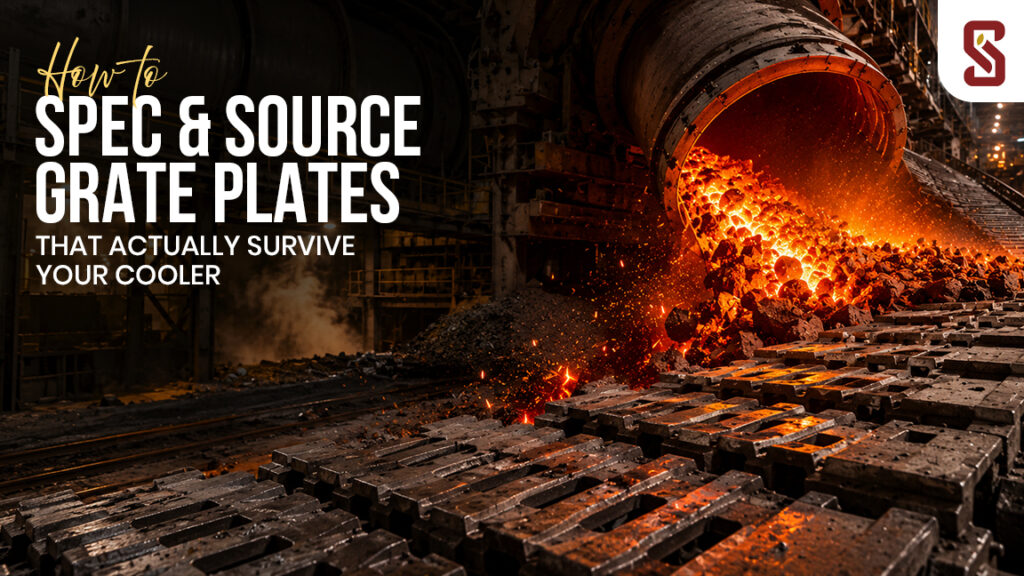
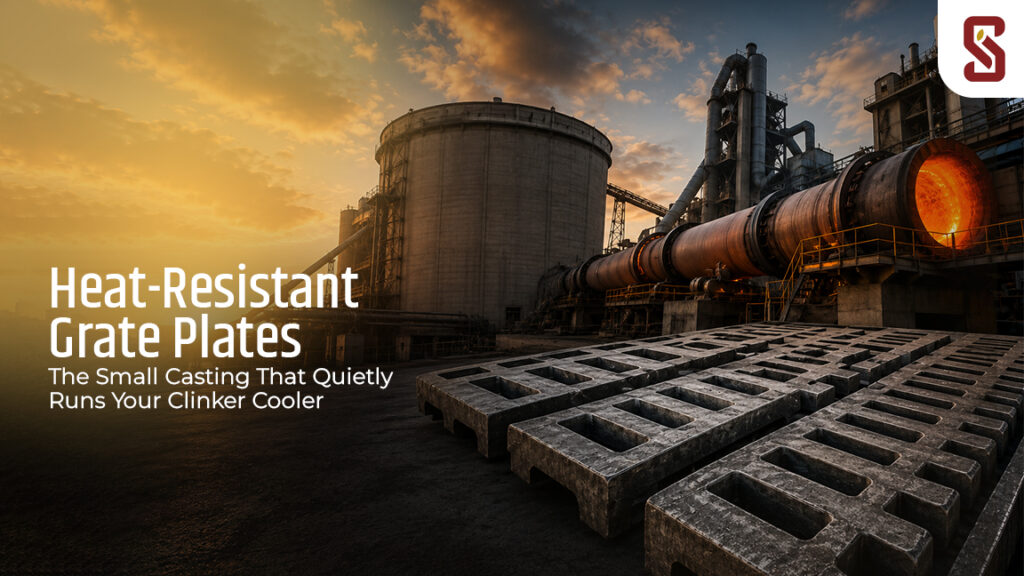
For furnace internals, heat-treatment fixtures, and similar high-temperature duty, ordinary steel scales and creeps. Heat-resistant grades such as HK40 carry high chromium and nickel so they hold their structure and resist oxidation at temperatures where other steels give up. The grate plates and heat-treatment trays we pour fall squarely in this family.
The Standards That Keep It Honest
Standards are what let a buyer in one city trust a casting poured in another. They define the chemistry, the minimum mechanical properties, the test methods, and the dimensional tolerances, so that a grade means the same thing everywhere. The ones referenced most often in our work are:
- ASTM — the American specifications (A216, A351, A148, A532, A128 and others) used widely by export and OEM customers
- IS — Indian Standards such as IS 1030 for carbon and low-alloy castings
- DIN / EN — the German and European specifications common in imported designs
- BS — British Standards still cited in older drawings
A casting certified to the right standard is one a buyer can fit and forget. That is the whole point of grading.
How a Graded Casting Is Actually Made
Getting the grade right is a chain of steps, and a slip at any one of them shows up in the final result.
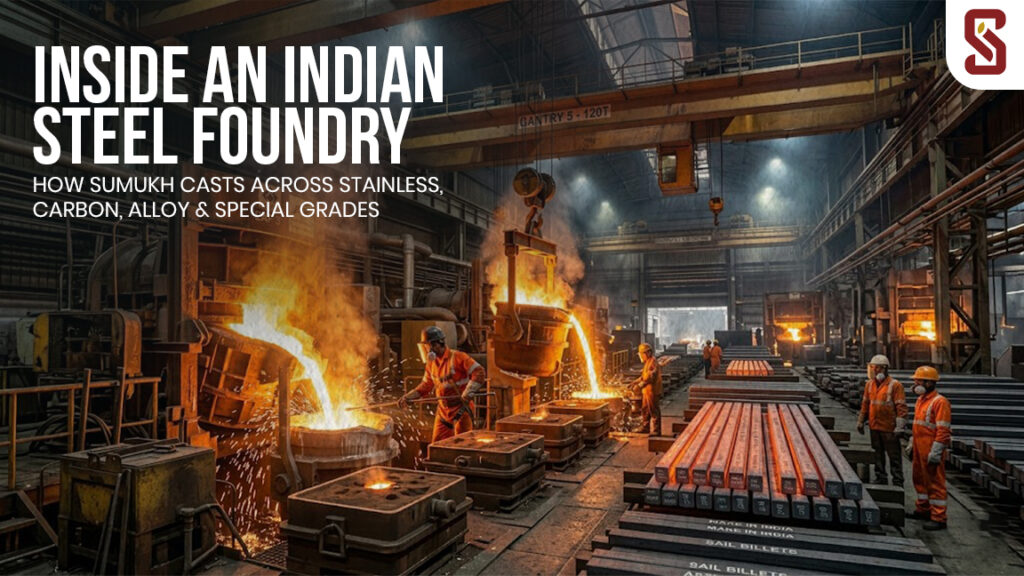
It begins with the charge mix selecting scrap, returns, and ferroalloys so the melt lands inside the chemistry window for that grade. Next is melting and refining in the induction furnace, where the bath is brought to temperature and the composition is trimmed; we confirm it on the spectrometer before anyone pours. The metal then goes into a mould built to the correct process for the part, whether shell, CO₂ silicate, or no-bake, with the gating and feeding designed so the casting fills cleanly and feeds its own shrinkage. After knockout comes heat treatment normalizing, annealing, or quench-and-temper depending on the grade which is where the mechanical properties are actually developed. Then fettling and machining bring the part to size, and finally inspection: Spectro chemistry, mechanical test results, and NDT such as dye-penetrant, magnetic particle, ultrasonic, or radiography as the specification demands.
Only when those records line up against the grade does the casting leave the works.
Where Graded Steel Castings Earn Their Keep
The grades above are not academic. Each maps onto real machines:
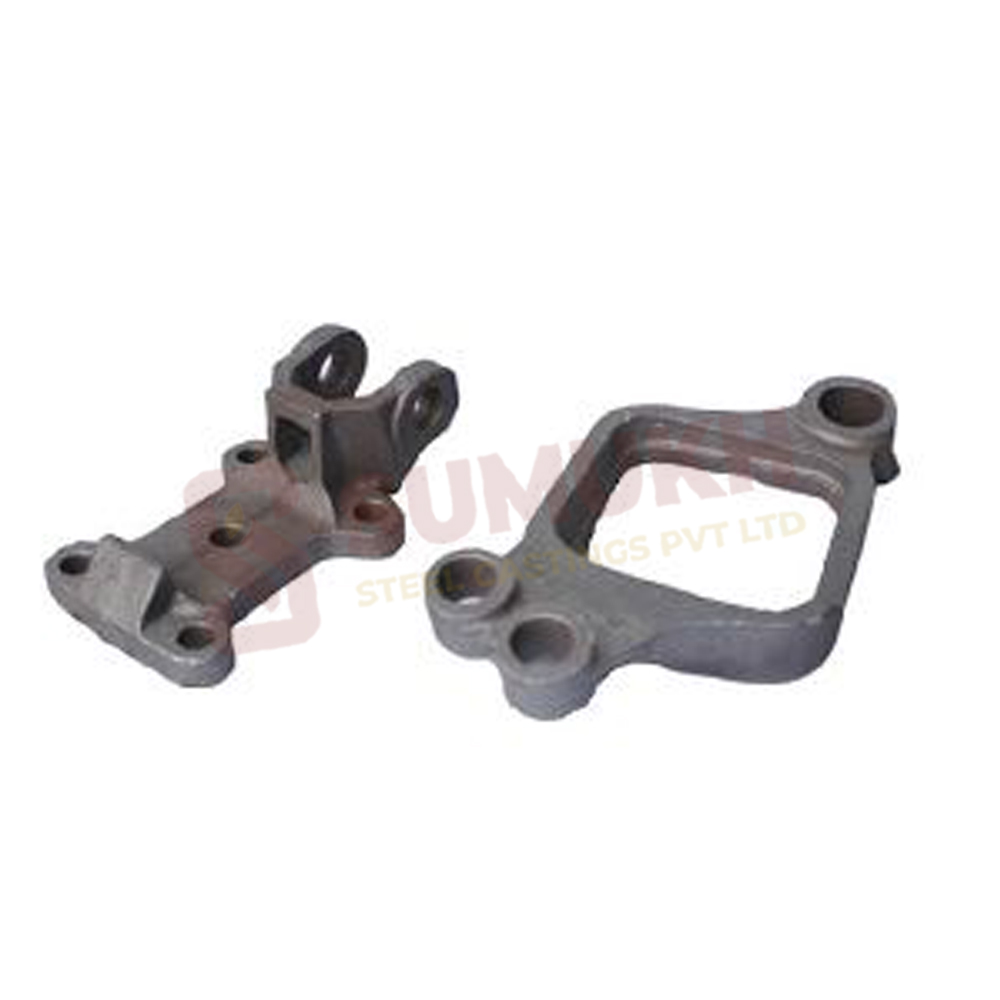
- Automotive and commercial vehicles rely on carbon and low-alloy castings for suspension parts, hangers, brackets, and load-bearing mounts that have to survive heavy loads and poor roads for years.
- Earth-moving and construction equipment uses tough low-alloy and manganese castings for parts that take constant abrasion and shock.
- Pumps and valves depend on stainless grades like CF8M and CA6NM to handle corrosive and high-pressure service.
- Power, mining, and process plant need the full spread from wear-resistant manganese liners to heat-resistant furnace fixtures.
Sumukh Steel Castings as a Source for Graded Castings
We have built Sumukh around exactly this discipline. From our works at Gokul Shirgaon MIDC in Kolhapur, we pour carbon, low-alloy, stainless, manganese, and heat-resistant grades to ASTM, IS, and DIN specifications, with chemistry verified on a Bruker Q4 spectrometer and solidification studied in AutoCAST simulation before the first mould is built. Our customers include established OEMs across the pump, compressor, and defense sectors, which is the clearest proof that the grading holds up where it counts.
Conclusion
Graded steel casting sit underneath a surprising amount of the machinery we rely on, and the grade is what makes them dependable rather than merely metallic. Choosing the right family carbon, low-alloy, stainless, manganese, or heat-resistant and holding it to the right standard is the difference between a part that lasts and one that fails early. Working with a foundry that treats the grade as the starting point, not an afterthought, is the surest way to get castings that perform exactly as the drawing intended.
FAQs
1. What are graded steel castings?
Graded steel castings are cast steel components manufactured to specific material grades and quality standards for reliable performance.
2. Which standards are used for graded steel castings?
Common standards include ASTM, AISI, ISO, DIN, and EN specifications depending on the application and industry requirements.
3. Why are steel casting grades important?
Steel casting grades determine mechanical properties, chemical composition, strength, durability, and corrosion resistance.
4. What industries use graded steel castings?
Graded steel castings are widely used in automotive, mining, construction, oil & gas, power generation, and heavy engineering industries.
5. How do I choose the right steel casting grade?
The right grade depends on operating conditions, load requirements, wear resistance, corrosion exposure, and industry standards.