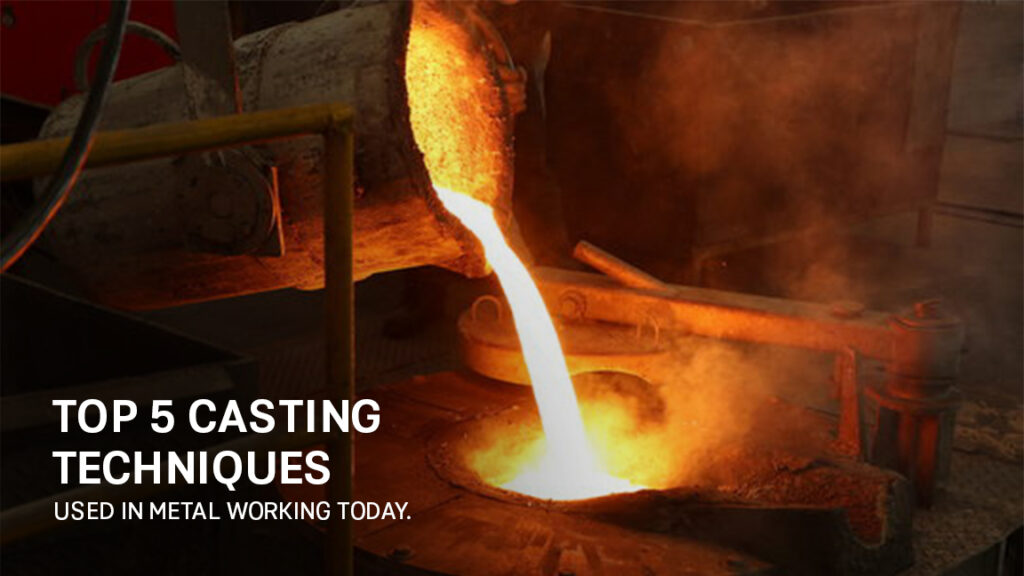
Casting is one of the oldest things humans do with metal, and also one of the most current. The basic idea has not changed in three thousand years melt the metal, pour it into a cavity, let it freeze into shape but the ways we build that cavity have multiplied enormously. Each method that survives today does so because it solves a particular problem better than the rest. Here are the five that matter most in modern metalworking, what each is good at, and where it falls down.
We pour several of these ourselves, so where it is useful I will say plainly which ones suit which jobs.
1. Sand Casting
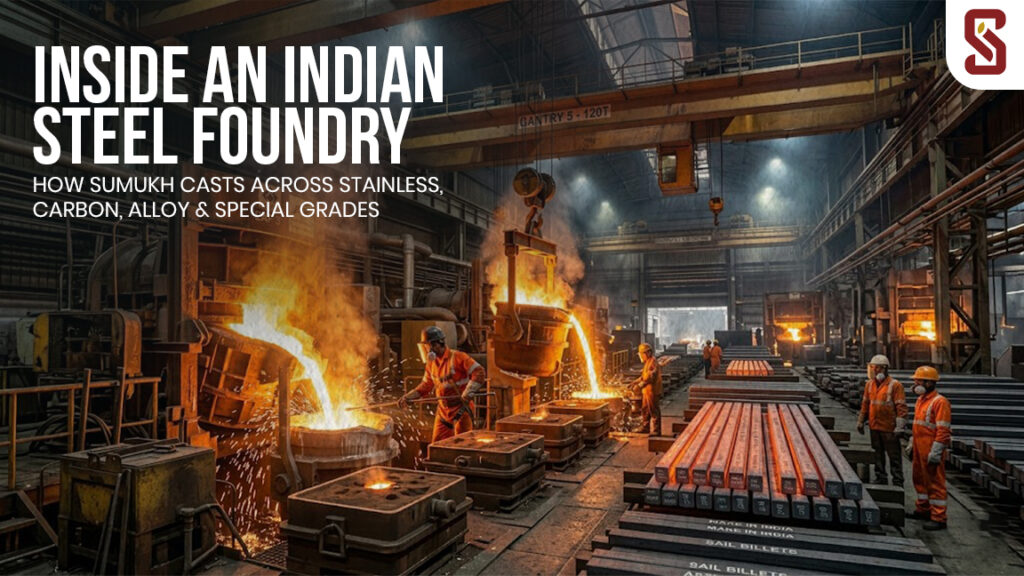
Sand casting is the one that does the heavy lifting. A mould is packed in bonded sand, the metal is poured under gravity, and the mould is broken away once the part has solidified. It sounds simple, and at its core it is, which is exactly why it is so versatile.
Its strengths are size, material range, and cost. A sand mould can hold castings from a few kilograms to several tonnes, and it will take almost any metal carbon steel, alloy steel, stainless, cast iron, manganese, bronze. The tooling is a pattern rather than an expensive die, so it suits everything from a one-off prototype to a steady production run. That is why engine blocks, pump housings, valve bodies, machine bases, and heavy structural parts are so often sand cast.
The price you pay is finish and tolerance. As-cast surfaces are rougher than other methods and dimensions are looser, so critical features usually need machining afterwards. Modern variants narrow that gap considerably shell moulding gives a far better surface and tighter tolerances, and no-bake and CO₂ systems improve dimensional stability on larger work. Sand casting in its various forms is the core of what we run at Sumukh Steel.
2. Die Casting
Die casting goes to the opposite extreme: speed and precision at high volume. Molten metal is forced into a reusable steel die under high pressure, fills fast, and comes out smooth and dimensionally accurate.
Because the steel die survives thousands of cycles and the cycle time is short, die casting is unmatched for mass-producing smaller parts think transmission housings, electrical enclosures, and connectors. The surface quality is good enough that many parts need little finishing.
The limits are real, though. The dies are costly, so the process only pays off over long runs, the part size is restricted by machine capacity, and the high melting point of ferrous metals keeps die casting essentially confined to aluminum, zinc, magnesium, and copper alloys. It is not a process for steel castings.
3. Investment Casting
Investment casting, or the lost-wax process, is the choice when detail and surface quality matter most. A wax pattern is coated in ceramic to build a shell, the wax is melted out, and metal is poured into the hollow that remains.
What you get is exceptional. Fine detail, tight tolerances, intricate geometry with internal passages, and a surface so clean that little or no machining is needed across almost any alloy. That is why it shows up in turbine blades, surgical instruments, and complex precision components.
It is also the slowest and most expensive of the common processes. The multi-step shell building takes time, the materials are specialized, and part size is generally limited to small and medium components. You choose it when the part genuinely demands what it offers, not as a default.
4. Permanent Mould (Gravity Die) Casting
Permanent mould casting sits between sand and die casting. Metal is poured under gravity into a reusable metal mould no high pressure, but a metal mould rather than sand.
The reusable mould gives better surface finish and tighter tolerances than sand, and the faster cooling against metal produces a denser, finer grain structure with good mechanical properties and consistent repeatability. It suits medium-volume runs of parts like pistons, cylinder heads, and gear housings, usually in aluminum, magnesium, copper alloys, or some cast irons.
The tooling costs more than a sand pattern, so it does not suit low volumes, and it is less capable of very intricate detail than investment or die casting and not practical for very large parts.
5. Centrifugal Casting
Centrifugal casting is the specialist of the group. The mould spins while metal is poured, and the rotation throws the metal outward against the mould wall.
That spinning does something clever: it drives the dense metal to the outside and pushes lighter impurities and gas toward the center, producing parts with excellent density and metallurgical soundness and a clean, sound outer wall. For symmetrical hollow shapes pipes, tubes, bushings, bearing sleeves, large rings it needs no central core at all, and the grain structure it develops gives real strength.
The catch is in that word symmetrical. Centrifugal casting is essentially limited to cylindrical and rotationally symmetric parts. Step outside that geometry and it no longer applies.
How They Fit Together
In practice these processes are complementary, not competing. A foundry picks the method that fits the part: sand for the big, the ferrous, and the made-to-order; die casting for high-volume non-ferrous precision; investment casting for fine detail; permanent mould for medium runs; centrifugal for symmetrical hollow shapes. And most castings, whatever process makes them, go on to be machined to final dimensions casting gets the part close to net shape, and machining brings it the rest of the way.
Conclusion
The right casting technique is the one matched to the part in front of you its metal, its size, its volume, and the tolerances it has to hold. Sand casting remains the backbone of heavy and ferrous work, while the other four each own a niche where nothing else does the job as well. Understanding those trade-offs before tooling is committed is what separates a casting that performs from one that disappoints, and it is the conversation worth having with your foundry early rather than late.
FAQs
Q1. Which casting technique is best for precision metal parts?
A: Investment casting is widely preferred for producing highly accurate and complex metal components.
Q2. Why is sand casting popular in metalworking?
A: Sand casting is cost-effective, versatile, and suitable for both small and large metal castings.
Q3. What industries use die casting the most?
A: Automotive, aerospace, electronics, and industrial manufacturing industries frequently use die casting.
Q4. How does centrifugal casting improve product quality?
A: Centrifugal casting creates dense, durable, and defect-resistant cylindrical metal components.
Q5. Which method is ideal for high-volume production?
A: Die casting is one of the best choices for fast, consistent, and high-volume metal part production.